
Your last feature has been buried in the feature request tool for over nine months.
If your SaaS provider won't let you connect your preferred AI to their drag-and-drop funnel builder to do all the work for you in minutes, and won't let you pull the repo either, you're not a customer. You're a tenant. Welcome to the Overpriced SaaS Exodus.
Press play, then read along below. The video is about 8 minutes.

My name is Kimball Roundy. I'm a farmer. Not long ago, I was a poor farmer selling firewood to get by.
Years ago I ran a software business: fourteen developers in Costa Rica and an office in Utah full of good people in admin, sales and support. I'd done old HTML and PHP. But modern web architecture? None.
Around February of 2025 I started using ChatGPT to help write content for a new YouTube channel. Then I tried to build a community website. It didn't work. Honestly, I didn't understand what AI even was.
In December of 2025 I asked Claude if it could do what ChatGPT couldn't. It suggested a Next.js front end, a Node.js back end and a Supabase Postgres database. I turned to my son and asked, "Do you know what that means?" Not a clue. It might as well have been written in another language.
Then I changed one thing
I stopped asking the AI if. I started asking how.
I think AI is slightly misnamed. For ordinary folks, what it really gives us is Artificial Un-Earned Abilities. I'm a guy with dirt under his fingernails. But I can have a conversation. And so can you.
All of us together, back in the Costa Rica and Utah days, couldn't have come close to the code I've built with AI in the last ten months. I say that humbly. It isn't me. It's the conversation.
And once I saw that, I saw something else about the whole SaaS game. That's where this page really starts.
Welcome to the Overpriced SaaS Exodus
If your SaaS provider doesn't let you connect your preferred AI to their drag-and-drop funnel builder to do all the work for you in minutes...
But also won't let you pull the repo and build anything you and your AI can imagine into their tech stack, then you are boxed into their rules and their toolsets.
Instead, you get exiled to the feature request tool, where your last feature has been buried for over nine months. (Or maybe it's just me?)
Glad to have you with us, building the New Internet.
Here's the premise I landed on. If I can build the SovereStack in ten months with current frontier models, then any company that won't give you the keys is on a timer. Either they give you 100% freedom to do what you want with your own AI, or eventually they die. Because it's only a matter of time before paying for SaaS is over.
Terms aren't evil. Terms simply protect one party more than the other. And whoever sets the terms controls the kingdom they govern.
Whoever sets the terms rules the kingdom. It's time to set your own.
Most of us live online under someone else's terms. And when you try to build your own place, you hit a second wall: hosting, DNS, SSL certificates, NAT traversal, encryption. Those are the old moats around the castle.
In 2016 I spent so much time teaching my software customers the technical stuff that I created the Periodic Table of Internet Marketing Elements, and Elemental Formulas showing how it all fits together.
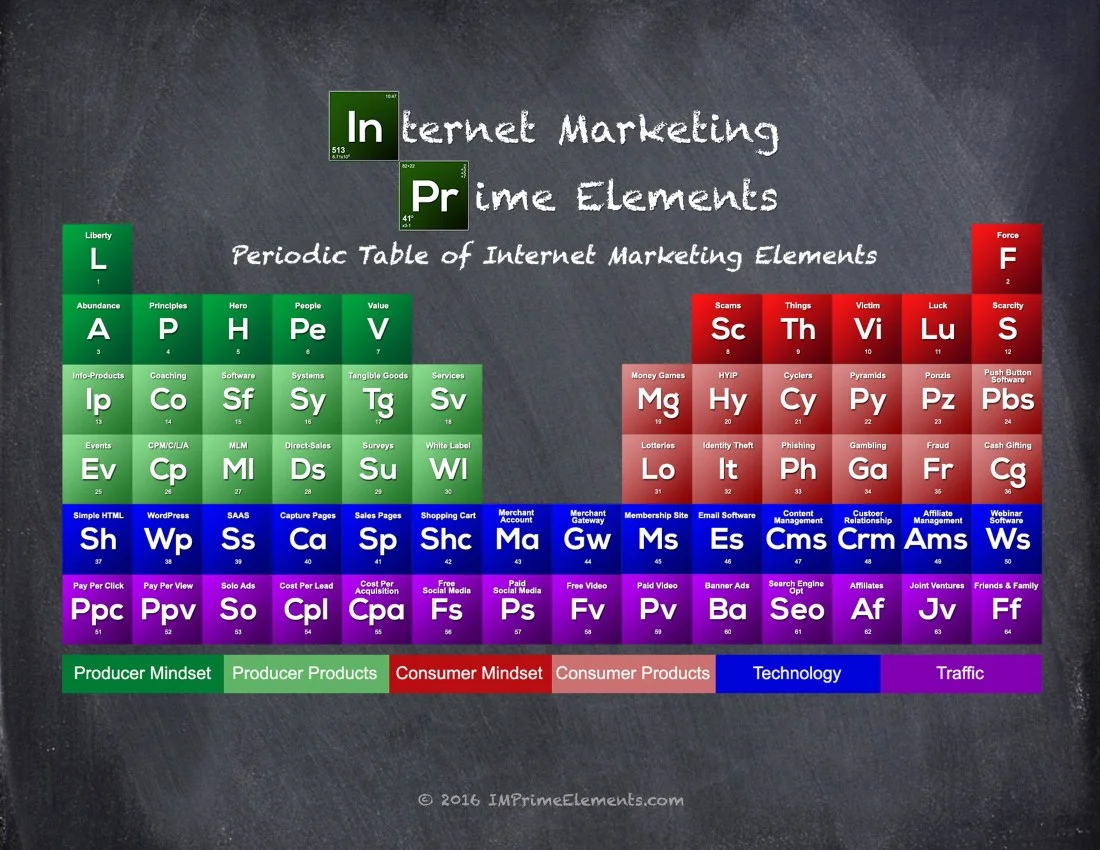
I recorded the launch videos. And then I never launched it. Even with all that detail, I was afraid it was still too hard for the average person. Because the biggest killer of creativity is one simple sentence: "I don't even know where to start."
Today there are a million drag-and-drop builders that make it "easy." But the human still has to do it. Even with the best of them, you still connect your own domain and deal with DNS. Then you're still the one figuring it out, and doing the dragging and dropping.
That sentence is exactly what the conversation kills. You don't start with a dashboard, a domain panel, or a drag-and-drop canvas. You start with a sentence. You tell your AI what you want, and it does the building. That's the whole start.
Sovere: your own Kingdom on the King's New Internet
That conversation became the SovereStack. It runs on your own computer, your own home internet, your own domain, powered and secured by AI. And the formulas I drew on that chalkboard in 2016 became the foundation of its design, so you don't need to know them. Your AI can build with them.
A Kingdom, not a profile: the Barbican Market out front, Courtyards behind the walls, the Castle at the center.
The Barbican Market
Everything you show the world: the square (your SovereSpace), the press (your SovereBlog) and the shops (your SovereShops).
Private Courtyards
The back rooms where your people gather, learn and work, behind gates that open only for the people you choose.
Iron Rod Sovereign Key
The Halo and the ChipGate: keys to your gates whose combination only you know. That is what makes it sovereign.
Your Castle and SovereNode
Your family, your private library, your work in progress, and the machine that holds it all, on your own ground.
ThoughtCoding
An MCP connector lets your own AI make any change you'd make yourself. No logging in to drag and drop, unless you like to. The drag-and-drop tools are all still there.
Open source, CrownSource
Every non-custom component is Apache 2.0, and the combined work is released under Kimball's own CrownSource license.
Check my work
The source code, the Git issues and almost all of the build conversations are searchable by any AI you bring that connects over MCP. Ask it why anything was built. Fork it. Send a pull request back.
Stronghold failover
SovereNodes that can run on your neighbors' machines, so your Kingdom isn't renting a room in someone else's castle.
Davee, the house AI
A guide inside the Kingdom to help you find your way.

ThoughtCoding: ask your AI for the change, and watch it happen.
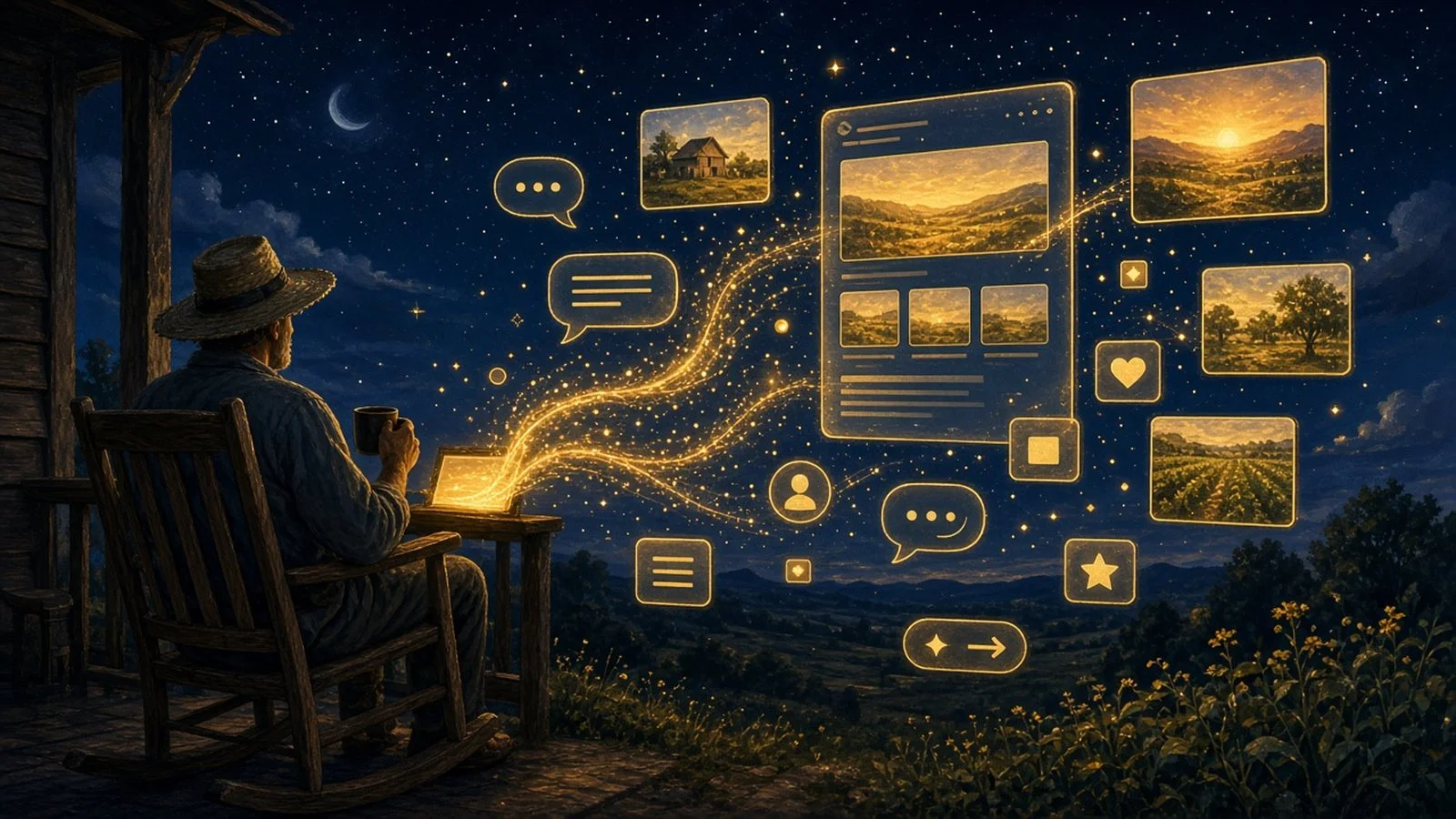
I know of no other platform that lets your own AI read why everything was built, and then help you build on it.
"Liberty to us means essentially embracing everybody's free agency, everybody's choice, no deception, no coercion."
Kimball Roundy, Periodic Table lecture, 2016. Liberty sat at the center of every formula. It sits at the center of this one too.
Your computer was built for more than email
I used to pay for more AI tools than I can remember. One for images. One for video. One for music, one for sound effects, one for transcripts. Every one had its own monthly fee and its own rules. Then I asked Claude what it would take to bring them all in-house, and those subscriptions went away. I still pay for the big frontier models. But for everyday art, music and writing, I don't have any other fees.
That's what the SovereNode does. It's a desktop program for Linux, Windows and Mac that lets your computer run any local or open-weights AI model it can handle, for art, music, writing and sound effects, about as fast as you can imagine them.
Then I hit the ceiling of my own 16 GB graphics card. And I realized every other person who tried this would hit the same ceiling. So we built the answer together: a Distributed Compute Network. When your machine would otherwise sit idle, it can take on work for the network, like podcast transcripts, AI art, music and sound effects, blog writing and other AI-managed tasks. When a job is too big for one machine, the network shares it.
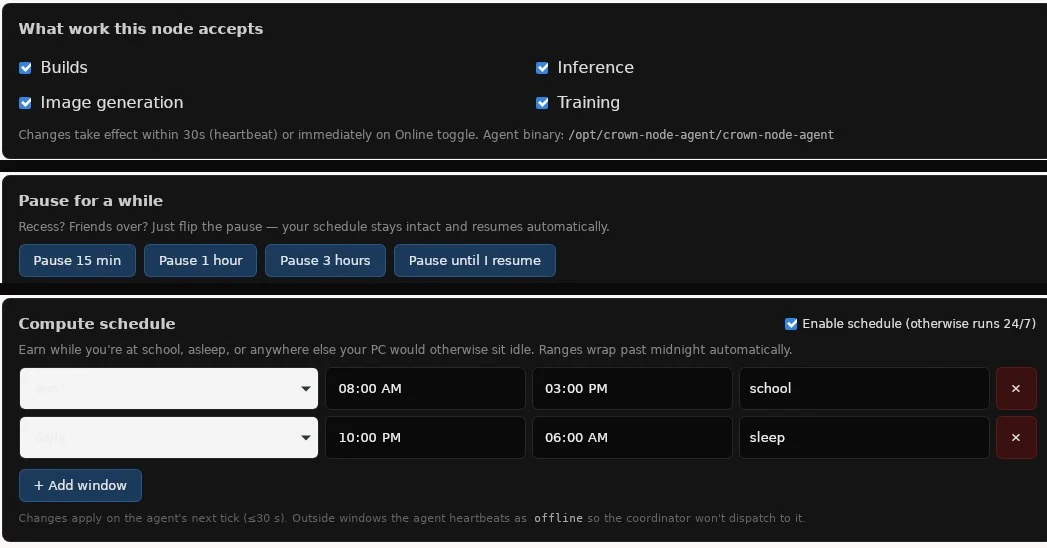
This is for everyday gamers and people with regular old computers. And you stay in charge: you pick the kinds of jobs your machine accepts, and the hours it works. Run it while you're at school or asleep. Pause it for fifteen minutes when friends come over.
You choose the work, the hours, and when to pause. And in the morning there's a literal Liquid Gold hourglass that shows how big the river of Digital Liquid Gold flowed into your node for the work it did the night before.
The network is still being switched on, and no compute revenue is flowing yet. The numbers on my own screen are examples while the rates are calibrated.
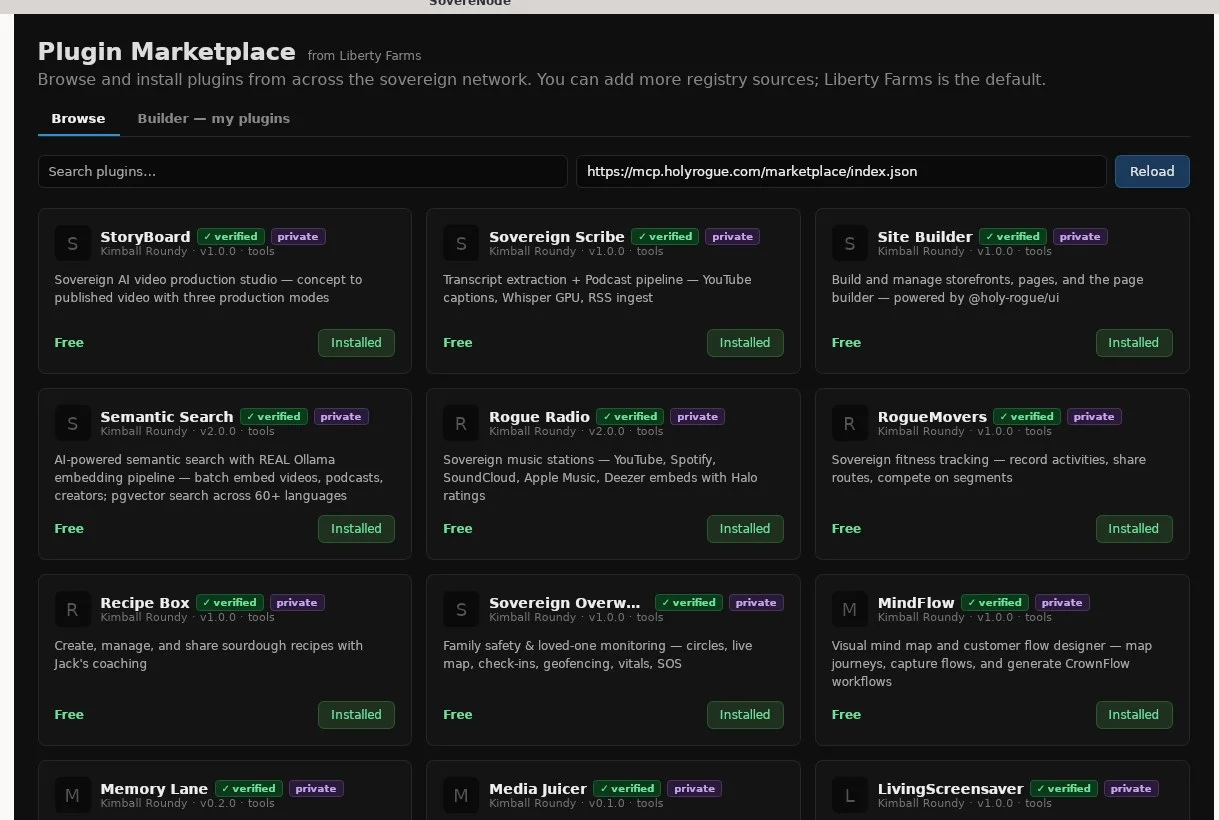
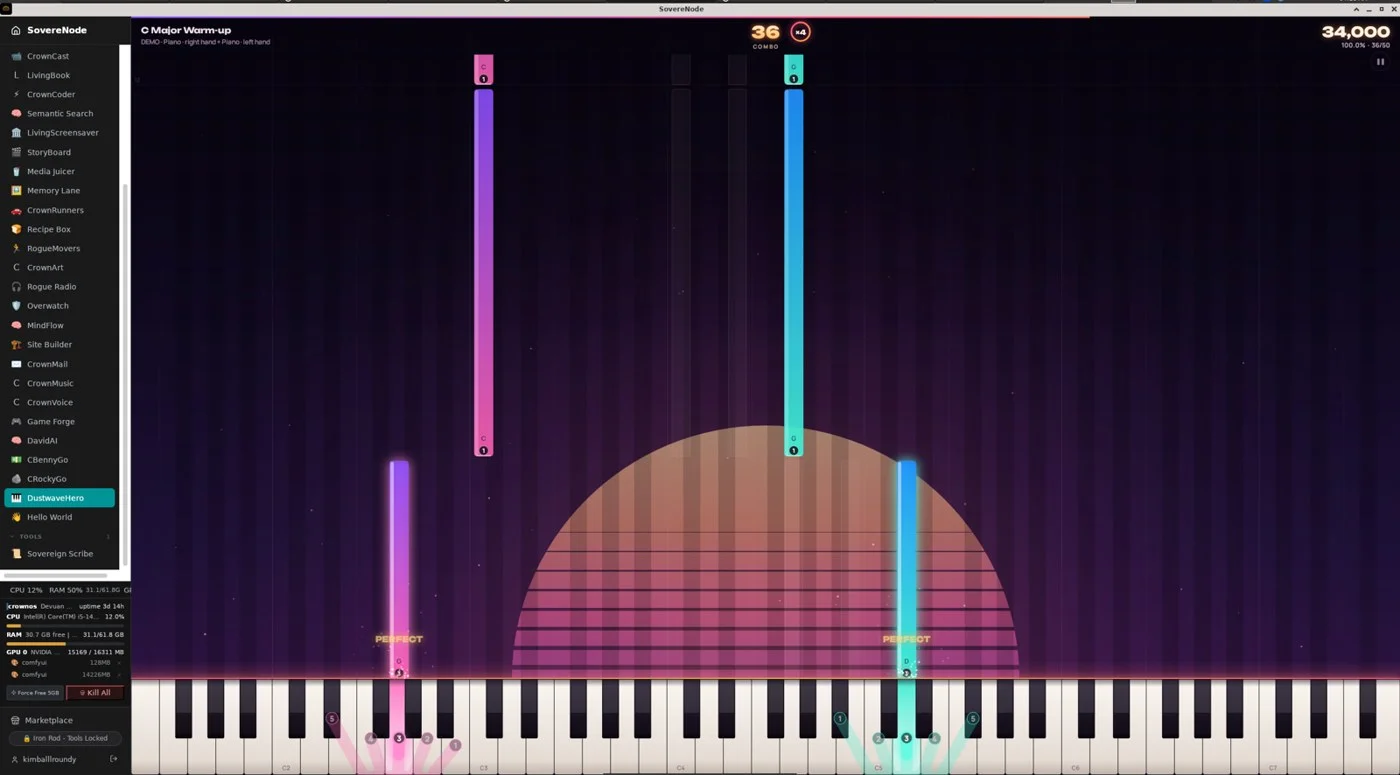
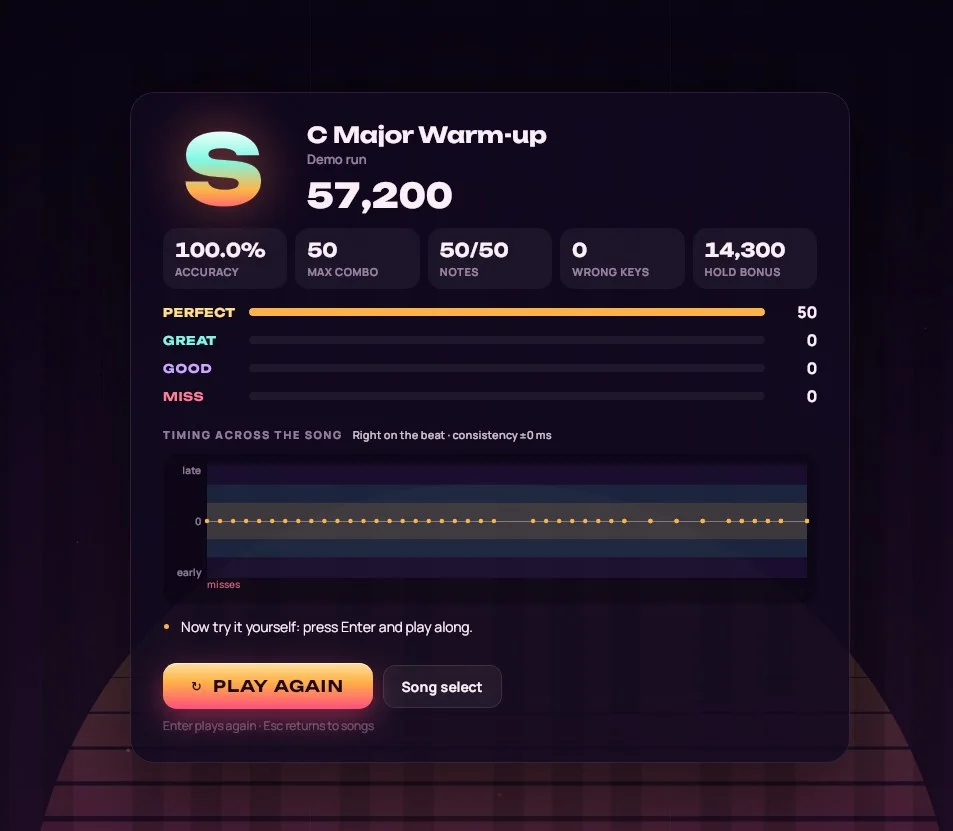
And you don't have to know a single line of code to add to it. Anyone with an AI connected over MCP can write a plugin for the Sovere network, because the AI does the coding. You describe what you want, and it builds it. One of my friends did exactly that with his Claude and the SovereStack. He built a music teaching app, where you pick your favorite instrument and learn to play it.
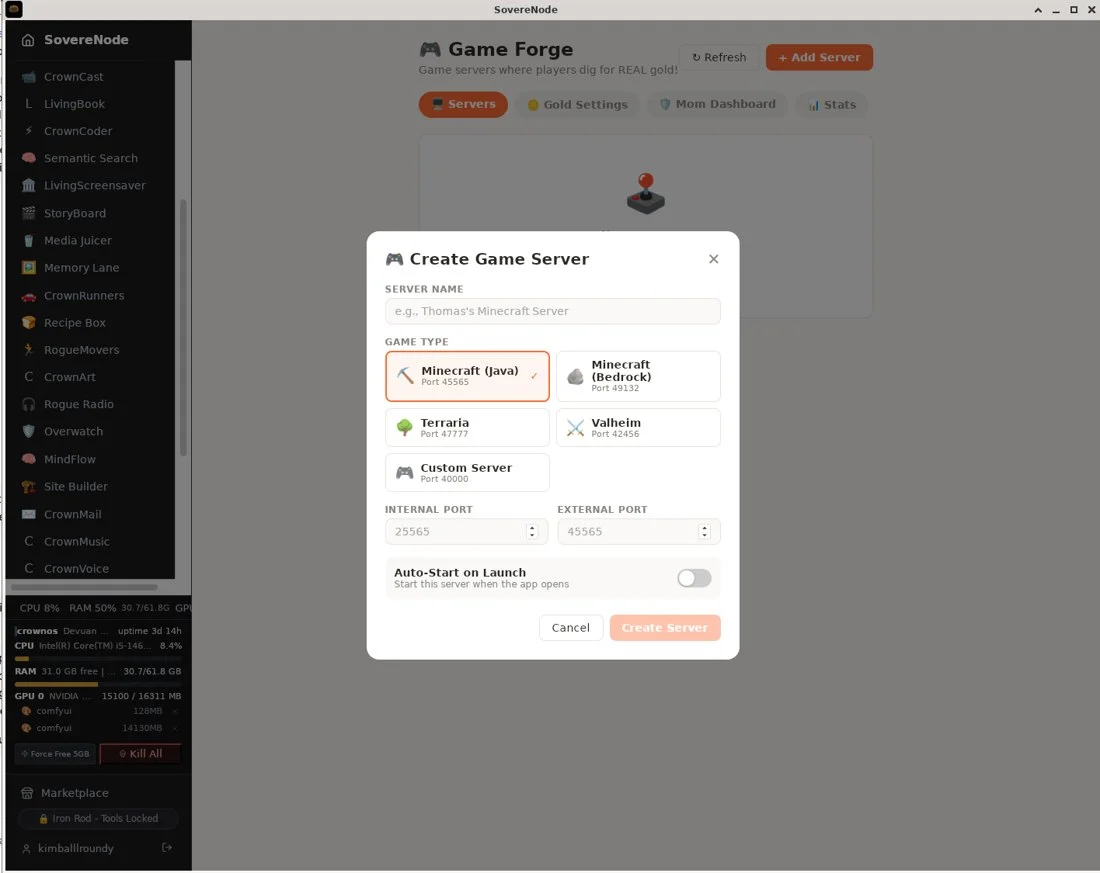
For the gamers: build your own server with Dad. One of the plugins is called Game Forge. It lets you set up your own game server, for Minecraft (Java or Bedrock), Terraria, Valheim or a custom game, right from the SovereNode. You and your dad can build it together on a weekend, and it's yours. No hosting fee, and no one else's rules.
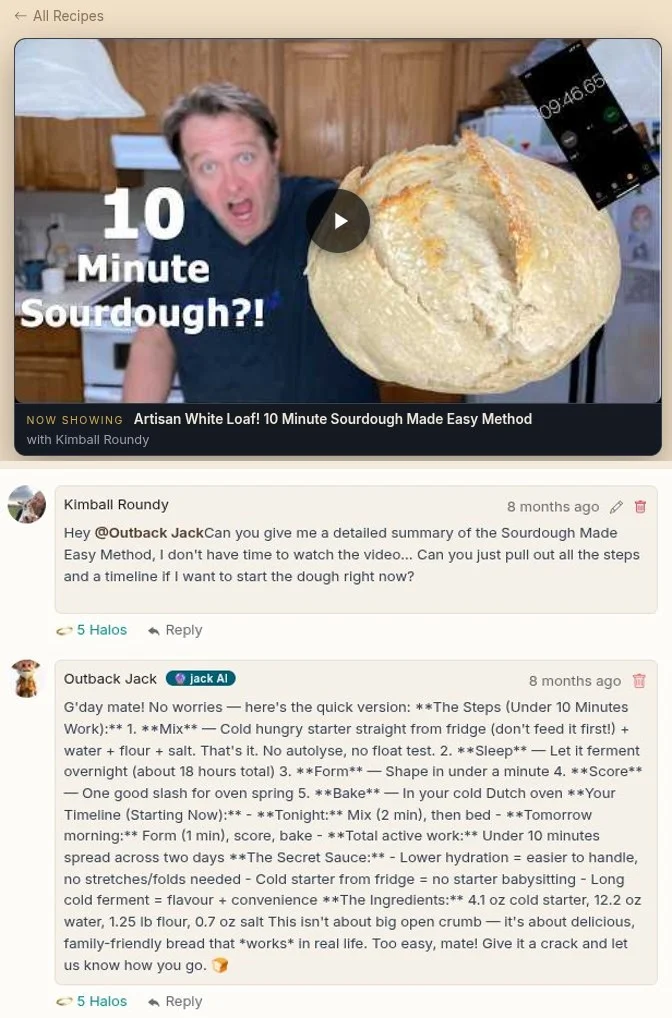
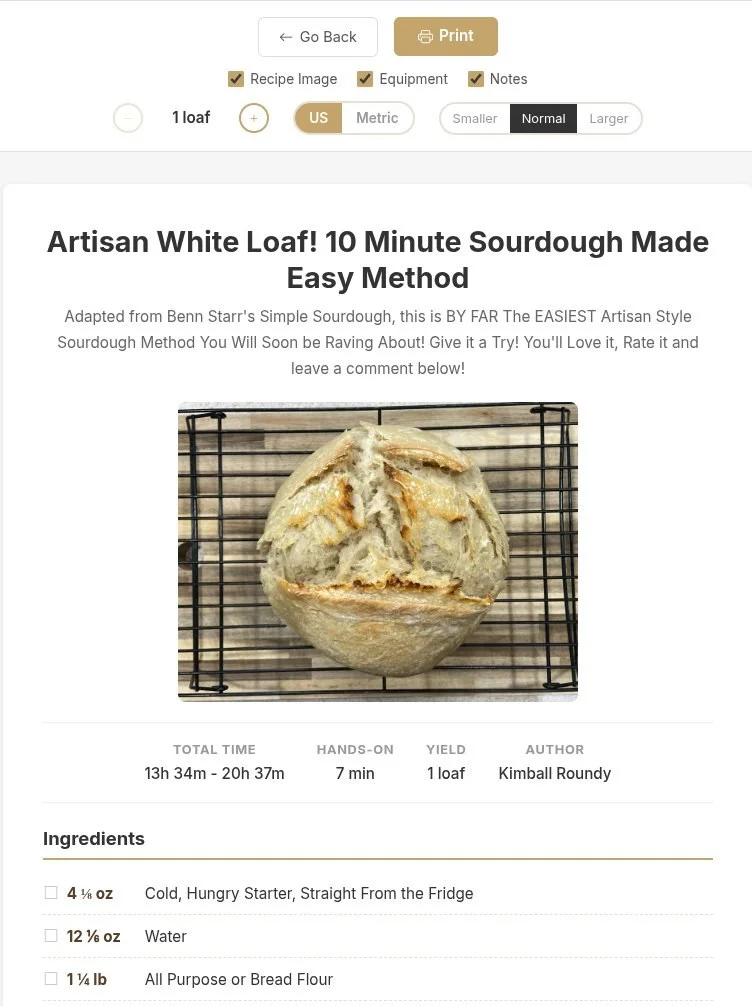
For Mom: the chef or baker she's always dreamed of. Meet Recipe Box, with an AI recipe coach built in. And we already have thousands of recipes from all your favorite food bloggers and vloggers, ready for Mom to pull into her own recipe box: more than 13,000 recipe cards from 34 creators so far.
Every recipe can have photos, a video walk-through and a printable page that scales the batch. And when she's stuck, she can ask the coach for the steps and a timeline, and it answers like a friend in the kitchen.
Everyday gamers. Farmers. Homeschool families. People with regular old computers. That's who this was built for.
With one conversation. Then pick your door.
Farmers, gamers, moms and dads at the kitchen table: this is for you. At sovere.ink/stronghold you'll find three doors.
Plain answers
Do I need to know how to code?
No. Kimball couldn't build modern web software either. You have a conversation, and your AI does the building through the Sovere MCP connector.
Can I still drag and drop if I want to?
Yes. If you like control and precision, all the drag-and-drop tools are still there.
Where does it run?
On your own computer, your own home internet and your own domain. It first ran on a gaming PC Kimball's son built him, and today runs on an old enterprise server on gig fiber.
Which AI do I use?
Bring your own. Any AI that connects over MCP can read the build history, explain the reasoning, and help you build.
Is it open source?
Yes. Every non-custom component is Apache 2.0, and the combined work is released under the CrownSource license.
Buried in the feature request tool for nine months.
You get the repo.
Claim your Kingdom.